
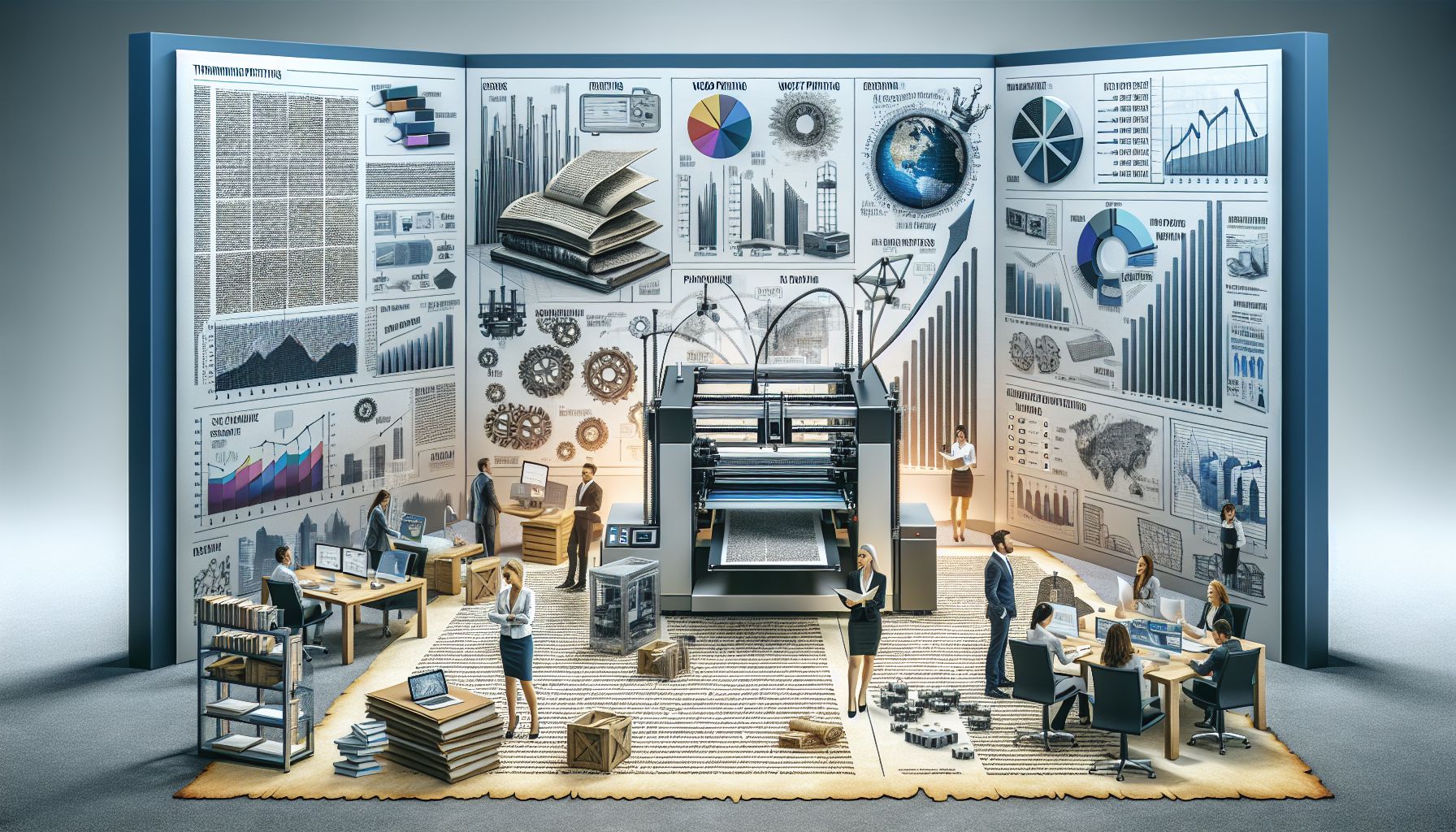
In today’s fast-paced digital world, it’s easy to assume that the printing industry is becoming obsolete. However, the reality is quite the contrary. The printing industry has undergone a significant transformation in recent years and continues to evolve at a rapid pace. From advancements in technology to the emergence of new consumer demands, several trends are shaping the future of this industry. In this blog post, we will explore some of the key trends that are revolutionizing the printing industry and discuss their implications for businesses and consumers alike.
1. The Rise of Digital Printing
One of the most notable trends in the printing industry is the growing adoption of digital printing technologies. Digital printing offers several advantages over traditional printing methods, including faster turnaround times, lower costs for small print runs, and the ability to produce customized and personalized prints. With the advancements in digital print quality and speed, many businesses are shifting towards digital printing as a more efficient and cost-effective solution. Furthermore, digital printing enables on-demand production, reducing the need for inventory storage and waste.
2. Sustainability and Eco-friendly Printing
As environmental concerns become increasingly prominent, the printing industry is also embracing sustainability and eco-friendly practices. Many printing companies are now investing in eco-friendly materials, processes, and technologies to reduce their carbon footprint. This includes using recycled paper, water-based inks, energy-efficient machinery, and implementing waste management systems. Moreover, customers are increasingly placing importance on sustainable printing practices, demanding environmentally friendly options. Thus, adopting sustainable practices has become a necessity for printing businesses to attract and retain clients in an increasingly eco-conscious market.
3. Personalization and Variable Data Printing
In today’s era of customization, consumers crave personalized experiences. The printing industry has recognized this demand and is leveraging technologies like variable data printing (VDP) to cater to individual preferences. VDP allows for the seamless integration of personalized data, such as names, addresses, and images, into printed materials. This trend is particularly relevant for direct mail campaigns, promotional items, and marketing collateral, as it allows businesses to target customers with highly personalized content. By harnessing the power of personalization, printing companies can deliver more impactful and effective marketing campaigns, resulting in higher customer engagement and conversion rates.
4. Augmented Reality (AR) Integration
With the proliferation of smartphones and tablets, augmented reality (AR) has emerged as a powerful tool for enhancing printed materials. AR integration in the printing industry provides an interactive and immersive experience for consumers. By scanning printed images or codes using AR-enabled devices, users can access additional digital content, such as videos, 3D models, or animations. This technology opens up new possibilities for printed marketing materials, packaging, and educational resources. By combining the physical and digital worlds, AR integration adds value to printed materials, increasing customer engagement and creating memorable experiences.
5. 3D Printing Revolutionizing Manufacturing
While 3D printing technology isn’t new, its impact on the manufacturing industry, including printing, cannot be underestimated. In recent years, 3D printing has evolved from a niche field to a mainstream phenomenon. This additive manufacturing technique allows the creation of three-dimensional objects by layering materials. The printing industry has immensely benefited from 3D printing, enabling the production of prototypes, customized promotional items, spare parts, and even complex architectural models. As the technology continues to advance and costs decrease, it is expected to revolutionize manufacturing processes, creating new opportunities and possibilities for the printing industry.
6. Integration of Artificial Intelligence (AI)
Artificial intelligence (AI) has the potential to transform the printing industry by enhancing efficiency, productivity, and cost-effectiveness. AI-powered solutions can optimize workflows, automate repetitive tasks, and streamline print production processes. For example, AI algorithms can analyze large sets of data to identify patterns and predict demand, enabling businesses to optimize their inventory management and reduce waste. Furthermore, AI can enhance color accuracy, image retouching, and prepress processes, ensuring higher quality printed outputs. The integration of AI not only improves efficiency but also frees up resources for more creative and strategic endeavors.
7. Expansion of Large Format Printing
Large format printing has experienced significant growth in recent years, driven by advancements in technology and increasing demand for visually impactful advertising and displays. Large format printers can produce high-resolution prints on various surfaces like vinyl, fabric, canvas, and rigid materials. This trend is particularly relevant for businesses in the retail, hospitality, and events industry, where eye-catching visuals play a crucial role in attracting customers. With large format printing, businesses can create vibrant banners, trade show displays, vehicle wraps, and even building-sized advertisements, effectively grabbing attention and building brand awareness.
Conclusion
As the printing industry continues to evolve, businesses must stay attuned to these emerging trends to remain competitive. Digital printing, sustainability practices, personalization, AR integration, 3D printing, AI adoption, and large format printing are all shaping the future of this dynamic industry. By embracing these trends, printing companies can meet the evolving demands of consumers, deliver more value-added services, and stay ahead of the curve. Moreover, the convergence of digital and print technologies opens up endless possibilities for creativity, innovation, and new business opportunities. The printing industry may be changing, but it is far from redundant.